
Walking Pole vs Trekking Pole: What’s the Real Difference?


If you’re looking for walking poles, you’ve probably seen two terms:
👉 Walking Poles👉 Trekking Poles
They may look similar — but they are designed for completely different purposes.
Choosing the wrong one can lead to:
inefficient movement
unnecessary fatigue
poor walking experience
Here’s what you need to know.
Walking Pole vs Trekking Pole — Quick Comparison
Feature | Walking Poles | Trekking Poles |
Primary Use | Fitness walking, urban walking | Hiking, mountain terrain |
Movement Style | Continuous Push & Pull | Plant → Push → Lift |
Surface | Paved roads, parks | Dirt trails, uneven terrain |
Goal | Rhythm, efficiency, full-body engagement | Stability, load support |
Motion Flow | Smooth and continuous | Step-by-step |
👉 The key difference is not the pole —👉 it’s the movement system behind it
What Are Walking Poles Designed For?
Walking poles are optimized for:
daily walking exercise
paved roads and park paths
long-duration, low-impact movement
The goal is simple:
👉 make walking smoother, more efficient, and more sustainable
Unlike traditional poles, modern walking poles support a Push & Pull motion, allowing:
continuous forward movement
natural arm swing
better full-body coordination
👉 Less interruption. More flow.
What Are Trekking Poles Designed For?
Trekking poles are built for:
mountain hiking
steep inclines and descents
uneven terrain
Their primary function is:
👉 stability and load-bearing support
The typical motion involves:
👉 Plant → Push → Lift → Repeat
This works well on trails —but on paved roads, it often results in:
constant lifting
interrupted rhythm
inefficient movement
Why Trekking Poles Feel Awkward on Pavement
Many beginners try using trekking poles for daily walking — and quickly notice something feels off.
That’s because trekking poles:
are designed to stop, not flow
rely on downward pressure
require lifting every step
👉 On hard surfaces, this breaks your natural walking rhythm.
Result:
less efficient movement
more fatigue over time
reduced upper-body engagement
A New Approach: Walking Support Systems
Modern walking poles are evolving beyond traditional categories.
Instead of focusing only on “support,”they are designed to improve how you move.
👉 This is where the concept of aWalking Support System comes in.
A well-designed system should:
guide natural movement
maintain continuous rhythm
reduce unnecessary strain
adapt to real-world surfaces (especially pavement)
Example: Push & Pull Walking System
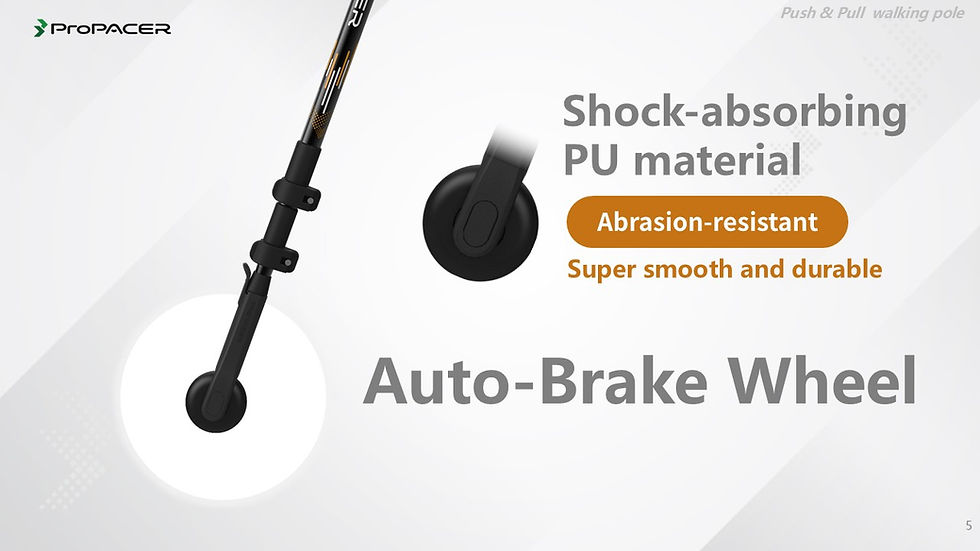
Some advanced walking poles (like ProPACER) introduce a Push & Pull system designed specifically for paved-road walking.
Key characteristics:
smooth rolling forward movement
stable support when pushing
no need to lift the pole each step
👉 This creates a simpler motion:
Push → Pull → Continue
Instead of:
Plant → Push → Lift → Repeat
Walking on Pavement Is Different
Most people don’t walk on mountains every day.
They walk on:
sidewalks
parks
city paths
👉 That’s why choosing the right pole for the surface matters.
Walking poles designed for pavement can:
reduce joint impact
improve walking rhythm
make movement feel more natural
Which One Should You Choose?
👉 Choose Walking Poles if you:
walk mainly on paved roads
want a smoother, more natural motion
aim to improve efficiency and endurance
👉 Choose Trekking Poles if you:
hike on uneven terrain
need stability on slopes
carry heavy loads
The Real Difference Isn’t the Pole — It’s the Experience
At the end of the day, both are tools.
But the experience they create is very different.
👉 One interrupts your movement👉 The other enhances it
Walk Smarter, Not Just Farther
If walking is part of your daily life,choosing the right system matters.
Because:
👉 the same steps can lead to completely different results


Comments