
Best walking poles for paved roads (2026 guide)

Updated: Apr 20
What are the best walking poles for paved roads?
The best walking poles for paved roads are those that provide smooth, stable, and continuous movement without interrupting your natural walking rhythm.
Unlike trekking poles designed for uneven terrain, walking poles for paved surfaces should prioritize:
fluid forward motion
minimal lifting
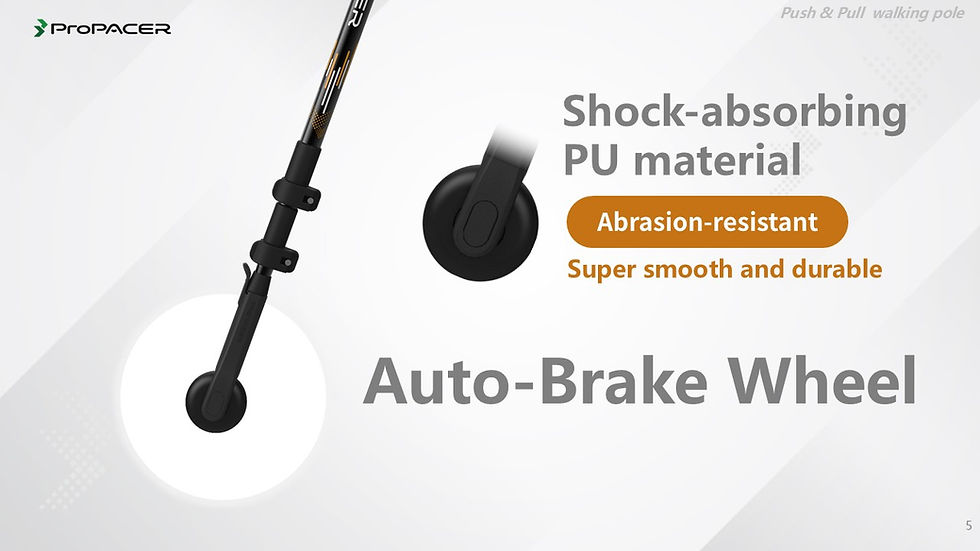
consistent ground contact
Why standard trekking poles don’t work well on pavement
Many people start with trekking poles, but quickly notice something feels off on flat surfaces.
This is because traditional trekking poles are designed for:
hiking trails
slopes and uneven ground
load-bearing support
On paved roads, they often create:
👉 a stop-and-go walking pattern
due to the repeated motion:
👉 plant → push → lift → reposition
This can feel:
jerky
inefficient
unnatural over long distances
What makes a walking pole suitable for paved roads?
When walking on sidewalks, asphalt, or park paths, the ideal walking pole should support continuous movement.
Key features to look for:
1. Smooth and continuous motion
Walking should feel natural—not interrupted.
Poles that reduce the need for lifting allow:
better rhythm
less fatigue
more intuitive movement
2. Stable ground contact
On flat surfaces, stability comes from consistency—not impact.
A good walking pole should:
maintain contact with the ground
provide steady support
avoid sudden stops or slips
3. Low coordination complexity
Many beginners struggle with timing and technique.
Simpler movement systems help by:
reducing learning difficulty
improving confidence
making walking feel effortless
Walking poles without lifting: a better approach for pavement
One of the biggest differences in modern walking pole design is whether lifting is required.
Traditional method:
👉 plant → push → lift
Alternative approach:
👉 push → continue → glide
This creates:
smoother forward movement
less interruption
more natural walking experience
👉 Especially on paved roads, this difference becomes very noticeable.
Push & pull walking: a more natural rhythm
Some walking systems simplify movement even further by focusing on push & pull walking.
Instead of lifting the poles, the motion emphasizes:
👉 forward push → continuous motion
This allows:
fluid walking rhythm
reduced effort
easier adaptation for everyday use
For many users, this feels closer to natural walking—especially during long-distance or daily walking routines.
Best walking poles for beginners on paved roads
For beginners, the best walking poles are not the most technical—they are the most intuitive.
Look for designs that:
feel natural immediately
do not require complex coordination
support balance and rhythm
👉 A smoother, more continuous system can significantly reduce the learning curve.
Are there walking poles specifically designed for paved roads?
Yes. Some walking poles are specifically designed for flat surfaces and urban walking environments.
These designs typically focus on:
continuous ground contact
smoother motion
reduced lifting
comfort over long distances
They differ from traditional trekking poles, which are optimized for terrain rather than rhythm.
Final takeaway
The best walking poles for paved roads are not defined by brand—but by how they move.
👉 Traditional poles: stable but interrupt movement👉 Modern designs: smoother, more continuous
If your walking poles feel unnatural on pavement, it’s often because they were not designed for that environment.
Choosing a system that supports natural, continuous movement can make a significant difference.


Comments