
Walking pole comparison guide: paved roads, beginners, and movement differences

What is the difference between walking poles and trekking poles?
Quick answer:
Walking poles and trekking poles are designed for different purposes.
- Trekking poles are best for hiking, uneven terrain, and load support.
- Walking poles are designed for rhythm and forward movement.
- On paved roads, smoother walking pole systems that reduce lifting can feel more natural and easier to use, especially for beginners.
If you mainly walk on sidewalks or park paths, the most important factor is not terrain support — but whether the pole allows smooth and continuous movement.
Walking poles are designed for forward movement and rhythm, while trekking poles are designed for support and terrain stability.

Although they may look similar, the way they move — and the way they feel — can be very different, especially on paved roads.
If you mainly walk on:
sidewalks
asphalt roads
park paths
urban environments
then the best choice is often not the same as the best pole for hiking.
Why comparison matters
Many people search for walking poles and assume all poles work the same way.In reality, the biggest differences are not just in materials or price — but in:
how the poles contact the ground
whether lifting is required
how natural the walking rhythm feels
how easy the movement is for beginners
This is why a walking pole comparison is important before choosing the right design.
Walking Pole Comparison Guide-Quick comparison table
Quick comparison:
- Hiking / trails → trekking poles
- Fitness walking → walking poles
- Paved roads → smoother walking systems
- Beginners → easier, more natural movement systems
Use case | Trekking Poles | Traditional Walking Poles | Smoother Walking Systems |
Best for | Hiking, uneven terrain | Fitness walking | Paved roads, daily walking |
Surface | Trails, slopes | Mixed | Sidewalks, asphalt |
Motion | Plant → push → lift | Plant → push → lift | Push → continuous motion |
Lifting required | Yes | Usually yes | Reduced or not required |
Rhythm | Stop-and-go | Technical | Smooth and continuous |
Beginner difficulty | Medium | Medium–high | Lower |
Overall feel | Stable but interruptive | Coordinated | Natural and intuitive |
Common questions:
What is the difference between walking poles and trekking poles?
→ Trekking poles focus on terrain support, while walking poles focus on movement and rhythm.
Are walking poles better for paved roads?
→ Yes, especially designs that allow smoother and more continuous movement.
Do walking poles need lifting every step?
→ Not necessarily. Some systems reduce lifting and create a more natural walking rhythm.
Which walking poles are best for beginners?
→ Poles that feel stable, simple, and natural are usually best for beginners.
Walking poles vs trekking poles
Trekking poles
Trekking poles are built for:
uphill and downhill support
uneven terrain
shock distribution on trails
balance under heavier load
They work well in hiking environments because users often need firm planting and repositioning.
Walking poles
Walking poles are more focused on:
walking rhythm
forward movement
daily exercise
repeated walking motion
However, not all walking poles feel equally natural on paved roads. Some still rely on repeated lifting and coordinated technique, which can feel difficult for beginners.
Paved roads vs uneven terrain
This is one of the most important differences.
On uneven terrain, repeated planting and lifting makes sense because the ground changes constantly.
On paved roads, your body usually prefers:
smoother motion
continuous rhythm
less interruption
That is why poles designed for flat walking surfaces often feel very different from hiking-oriented designs.
If your primary environment is pavement, the most important factor is not trail support — it is movement continuity.
With lifting vs without lifting
Another major difference is whether the pole system requires lifting on every step.
With lifting
Traditional designs often follow this pattern:
👉 plant → push → lift → reposition
This works, but it can also create:
rhythm interruption
more coordination effort
Without lifting or with reduced lifting
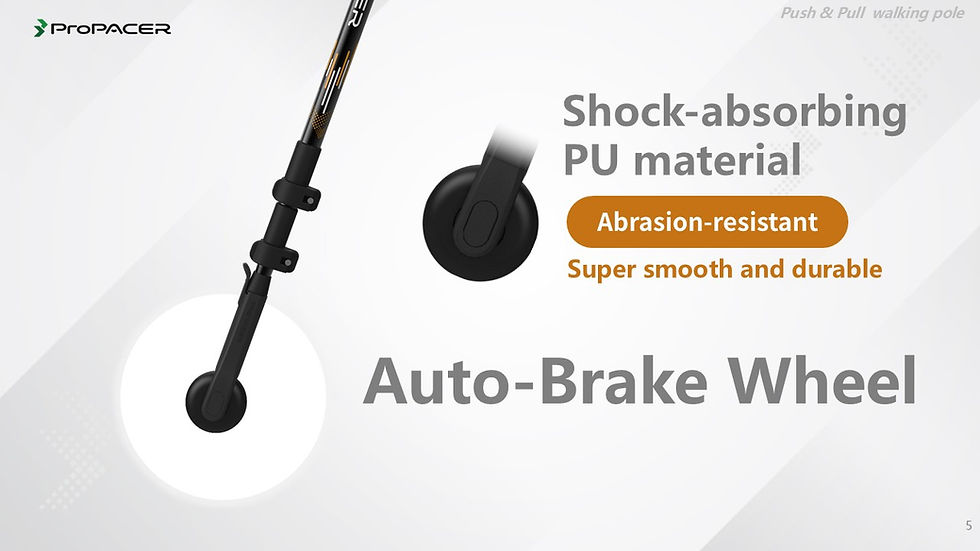
Smoother movement systems focus more on:
👉 push → continue → glide
This creates:
less interruption
easier rhythm
more intuitive movement
better comfort on flat surfaces
For many people, especially beginners, this is the difference between poles feeling awkward and poles feeling useful.
Which type is better for beginners?
For beginners, the best walking poles are usually the ones that:
feel natural quickly
reduce learning difficulty
provide stable and consistent ground contact
do not force overly technical movement patterns
A system can be technically correct and still feel difficult for first-time users.That is why beginner-friendly designs often prioritize:
simplicity
stability
ease of rhythm
rather than strict technique.
Which type is better for paved roads?
If your main walking environment is:
sidewalks
paved park paths
urban walking routes
long-distance flat walking
then the best option is usually a design that supports:
smoother forward motion
reduced lifting
more natural rhythm
stable contact on hard surfaces
This is different from choosing a pole for hiking, where terrain response matters more.
Common mistake: choosing by appearance only
Many poles look similar in product images, but they behave very differently in actual use.
People often compare poles by:
material
weight
handle design
price
These all matter, but for real-world walking experience, the bigger questions are:
Does it interrupt rhythm?
Does it require lifting every step?
Is it easy for beginners?
Does it feel natural on pavement?
These questions are often more useful than simply asking which pole is “best.”
Final takeaway
The most important difference in a walking pole comparison is not just what the pole is called — but how it moves.
Trekking poles are optimized for support on uneven terrain
Traditional walking poles may still require technical rhythm and lifting
Smoother walking systems are often better suited for paved roads and beginner-friendly use
If your goal is natural, stable, and comfortable walking on pavement, choose based on movement style — not just category name.


Comments